Tag: Book release

  • Or at least it does if I have correctly flipped all the switches and clicked all the clickables!

    Haroun’s book is really personal for me. I share disability spectrums with both Shai Madhur and Haroun, and I have a lot of friends who share intersectional communities, so the afterstuff is longer than it was for Chai and Cat-tales, but the story itself is also well over twice as long even before I added in 50-some pages of recipes.

    I am also drowning in small business minutiae on very little sleep; please pardon typos. Yesterday (9/6 as I’m prewriting this), I tried to do the marketing grind and also port my whole mailing list to a new provider because the current one decided this was the perfect month to halve their free tier and start charging more than I earn in an average month from book sales. And my brain just would not cope. Neither would my body or my eyes. So instead of being on the laptop juggling spreadsheets and logins, I was flat on my back with my tablet two inches from my nose, gleefully chatting zucchini/courgettes with Lacrima Mundi, QuiteBrief, Matt Mason, and Steve Hugh Westenra.

    QuiteBrief and I both live in what I colloquially refer to as zucchini country, meaning the part of the world where at certain times of year you know you must lock your car, your porch, and/or your garage to prevent drive-by depositing of boxes of tomatoes and various gourds of a size that double as blunt instruments which were discovered under overgrown leaves by avid gardeners.

    I have had to deal with 20 pounds of assorted squash in an entirely too short time window, and so zucchini bread, many soups, many stir fries, and mad fusion crossover food like potato-zucchini fritters and Carmarthenshire Welsh-meets-Korean variants on stwmp have made it into my experimental recipe collection. Matt has some delicious looking Greek variations in that thread and QuiteBrief’s chocolate zucchini bread also sounds intriguing.

    We also bonded over a mutual appreciation of shiso, which features prominently in both Japanese and Korean food, and it makes a delightful substitute for mint with a delicate pink color (even when you use the green shiso variant) in sekanjabin. Unfortunately it doesn’t dry very well, but it’s essential in Japanese umeboshi pickles (at least in my opinion). Sekanjabin uses up a lot more of it than umeboshi do, though. I’ve also considered a shiso pesto sort of notion to blend shiso leaves with an olive and sesame oil blend and freeze in ice cubes for later use. (At some point I’m going to blog the medieval form of za’atar from Haroun’s bonus recipe collection, which is basically pesto made with thyme and walnuts instead of basil and pine nuts, and this is a note to future me to come back and link this in.)

    I confess the chat did not make my small business obligations any shorter but it was a joy and a relief to just talk about food nerdery because I wanted to, not to grind more social media marketing performances because I was obligated to.

    And since I have 50 pages of not-yet-blogged recipes from Haroun to choose from, here’s one of them! One of these days I really will get around to the mega-post about sharbat, sekanjabin, shrub, switchel, and various international variants on “sugar + acid + flavoring = beverage,” but in the meantime, here is a sweeter version of Najra’s Crimson Witches’ Brew.

    Grandmother’s Karkadeh for Good Boys, Good Girls, and Good Folks

    Technically karkadeh could be made as a sharbat, like the shahzada’s fragrant almond, khus, and sandalwood sharbat from Chai and Cat-tales. But Najra’s Crimson Witch’s Brew is at the other end of the scale from a sharbat even though it’s based on karkadeh. A sharbat is a sweet syrup with a particular flavor used to make drinks and sometimes dressings, karkadeh is a sweet hibiscus drink, and Najra’s Crimson Witch’s Brew is the sourest combination of hibiscus and other tart things that you’re willing to put in your mouth.

    There are folk tales that the pharaohs also drank karkadeh, but unfortunately I haven’t found any references more concrete than “everyone says”-type marketing materials. I wouldn’t be surprised if hibiscus drinks have been made and consumed for that long – I just can’t document it.

    Here are three variations based on whether you’d like to store sharbat concentrate and dilute to taste when you want to drink it or whether you’d like to make a cup at a time.

    A pitcher for a party like Haroun’s:

    • 1/4 to 1/2 cup dried hibiscus flowers
    • Up to the same amount of sugar (optional but customary)
    • 2 quarts of water
    • Optional: A lime or some lime juice
    • Optional: Some rose water and/or mint sprigs

    Simmer the hibiscus flowers and sugar together until the liquid is bright red and the sugar (if you’re using it) is dissolved, usually 5-10 minutes. (If some people in the party want sugar-free, you could also make the tisane without sugar and serve a container of simple syrup on the side for folks to use or not use as desired.)

    When the color and flavor are as strong as you like, strain the petals out of the karkadeh with a sieve or cheesecloth.

    Chill until you’re ready to serve.

    Taste when cool, because temperature makes a taste difference. You might want to adjust the tartness with lime and/or simple syrup at this point. Add any rosewater after chilling, so that the flavors won’t evaporate with the steam.

    Decorate the pitcher or glasses with mint sprigs if desired.

    (If you plan to serve it with ice, use less water in the simmering to start with, so it will be less diluted by the ice melting.)

    For sharbat concentrate to save and dilute later:

    Low spoons? Monin sells a tasty hibiscus syrup that’s likely intended for tea shops, but I drink enough chai to be my own tea shop. So if you need any encouragement to become your own tea shop too, go forth and brew with all the tasty benedictions!

    Making your own: Instead of making the sugar 1:1 with the hibiscus, you’ll want sugar 1:1 with water (or 2:1 with vinegar for some sharbats), so that you have a condensed syrup that you dilute to taste later. Unfortunately, I don’t know of a no-sugar alternative for this type of syrup.

    • Up to 3 cups sugar, separated
    • 2 cups water
    • 1/4 to 1/2 cup dried hibiscus petals (or, if you have them fresh, as many as you can wilt into the pot)
    • (Optional) Juice and zest from 1-2 limes, about 2-4 Tbsp
    • (After cooling) Rosewater and/or mint sprigs if desired

    First, simmer the hibiscus petals and any optional lime zest for 10 minutes or so, in order for the flavor and color to be extracted. Use a sieve to strain out the petals and give them a good squeeze with the back of a spoon to extract all the liquid into the simmering pot. (I recommend removing the petals before adding the sugar because of how thick the syrup will be; you’ll lose a lot of syrup if you let it cling to the petals.)

    After the petals have been removed, while the hot hibiscus tisane is still simmering, add 2 cups of sugar gradually, stirring so that the sugar dissolves. This will be a thick syrup when cooled.

    Once 2 cups of sugar are dissolved in and the liquid is clear, adjust the sweetness/tartness with the lime juice.

    You can taste test with a tablespoon of sharbat in about a quarter cup of cold water to assess whether you’d like it stronger or sharper. Don’t entirely cool the syrup until you’re sure you have the balance you want, though; you might overcorrect the tartness with the limes and need to dissolve some of that third cup of sugar in.

    When you’re satisfied with the sweet-tart balance, cool the syrup. If you like rosewater, add a splash of it now. Store in the refrigerator until ready to use.

    When serving, plan for one part syrup to three or four parts of cool water, more or less. (Again, taste testing is your friend! I use a couple tablespoons of syrup per cup of water. If you use carbonated water, you have your own karkadeh soda.)

    For a sugar-free alternative, individual servings:

    • 1-2 tsp dried hibiscus petals
    • 1-2 cups hot water
    • (Optional) Sugar-free sweetener of your choice
    • (Optional) A slice of lime or sprig of mint

    I do like hibiscus tisane without any sweetener in it as long as I don’t stack too many other bitter-makers into it. Everyone’s tastes vary, of course! You can also make a sugar-free batch at the pitcher size and offer simple syrup on the side for those who partake.
  • So, uh. Note to future me:

    Don’t schedule three sales on your existing book, cover finalizing on two more books, final book generation on a ready-to-launch book, and writing the last 2-3 chapters on the first piece of a trilogy for the same week as the start of the university semester ever, EVER again, got it?

    (The whimpering sound you hear is the faltering remnants of my coping mechanisms.)

    I have probably gone off the wall with fifty pages of bonus recipes in the back of Haroun. But there’s a whole marketplace full of delicious nibbles, and Upaja’s cauldrons, and Grandmother’s karkadeh for good boys and good girls who are much too innocent to drink her kumiss. I wanted a lot of fun stuff to counterbalance the less-fun parts of the notes about living with multiple disabilities and how that informs both Haroun’s method of navigating a world he can’t see and Madhur’s method of navigating a world without motor vehicles when he owns very little other than his priest-cloths and his walking stick.

    Anyhow, I’m trying to wrap up the business-and-advertising pieces with my three-hours-of-sleep brain in order to unplug everything and force myself to finish off the three chapters that have been fighting me since June. It’s tricky to figure out exactly where to land Chai and Charmcraft’s plot plane when it’s the first book of a trilogy, you have to leave certain connections unresolved for the next two books to have launch points, you also have to have a satisfying-for-this-book pause point, and your main character is a prophet!

    So, if the universe does not laugh too loudly (I say while knocking on both wood and my skull to avert mishaps), I’m hoping to release (or unleash) Haroun on September 13.

    That’s if the proof prints come in acceptably and if I haven’t too badly bolloxed up the existence of both an Amazon paperback and a Draft2Digital-to-many-places-and-it-might-try-to-horn-in-on-Amazon-I-don’t-know-yet paperback with different ISBNs which I have heard both “it’s fine” and “you have set yourself up for an irretrievable and expensive identity hairball” about from different sources?

    I would very much like to make paperbacks available to libraries who won’t buy from Amazon! But if this all goes sideways, the non-Amazon edition is going to be what has to go. 95% of my sales come from Amazon, and less than 1% of those are paperback. So if I get caught in the middle of Dueling Paperbacks, 1% of 5% means I’m unlikely to sell more than one non-Amazon paperback every five to ten years, and at that point it’s not worth the bureaucratic combat.

    So, a pickle recipe sounds very, very appropriate for the current situation, wouldn’t you say? Somehow “pickle” is turning out to be frequently associated with “paperback complications” in my life!

    Salted Lemon Pickles

    Salted lemon pickles are a staple ingredient across much of the lemon-producing swathe of the world, from California to Africa to Vietnam. We find recipes from the tenth century onward, and I’m pretty sure they were making them before anyone wrote it down in a copy that survived.

    Nawal Nasrallah’s Treasure Trove’s recipe 607 in the Google Scholar preview is very like Daniel Newman’s Sultan’s Feast recipe 226, and these are very similar to how I’ve seen modern bloggers describe the making of salted lemons: cutting them in quarters and covering with salt and lemon juice and then topping with olive oil (or otherwise making sure the jar is full and airless).

    Out of spoons? You can buy jars of salt preserved lemons online as well!

    The Sultan’s Feast recipe 226 says: “Score lemons crosswise and fill the cuts with salt. Layer the lemons on a platter and weigh them down with stones. Cover and leave for three days [Kanz 607 says two]. Then take them out, put in a large glass jar and take the liquid. Dye it with saffron and take out the pips. If you want [more] lemon juice, add some. Then tightly pack everything in a jar, making sure [the lemons] are immersed. Seal with good quality olive oil, put a lid on top, and store.”

    Some key details here:

    • You need a lot of salt. Probably more salt than you’d guess. Kosher salt or sea salt is better than iodized salt for this purpose; medieval cookbook writers didn’t have iodized salt.
    • You need a lot of lemon juice too. They really do need to be submerged. A pickling weight can help keep them under the surface. (You can get the extra juice from standard lemons since you won’t be eating the peel of those.) Because the peels are included and most Western recipes assume you aren’t eating the lemon peel, you may want to look for organic lemons to avoid pesticides and preservational waxes applied to the surface of standard lemons.
    • If you can find doqq, boussera, or Meyer lemons, which are generally small and round they’ll have thinner pith and more flesh than the longer and pointier varieties of lemon.

    Christine Benlafquih of Taste of Maroc has an excellent article with helpful photographs of both homemade and market-bought salted lemons at different lengths of pickling. I admit I’m one of those not-in-plastic purists, though, and a pint or quart Mason jar is easier for me to calibrate by than “whatever your nearest empty container happens to be.”

    For one quart or two pint jars, ideally sterilized before use:

    • 6-12 Meyer lemons or similar round lemons, preferably organic
    • Additional lemon juice from whatever’s handy, possibly a cup or more
    • A couple cups kosher or sea salt (non-iodized)
    • Saffron if you’d like Even More Yellow
    • Optional but helpful: Two nesting glass or ceramic bowls that fit together neatly, or two plates with a lip to catch juices, very clean
    • Optional: Olive oil to separate the lemon juice from the top of the jar(s), if the jar lids are metal rather than glass or plastic

    Wash and dry your lemons thoroughly to remove any contaminants from travel.

    Cut your lemons in quarters, not quite all the way through.

    Scatter a couple tablespoons of salt in the bottom of your bowls if you have them, or your pickling jar(s) if you don’t.

    Coat every surface of your lemon with salt, including stuffing the insides of the cuts.

    If you have nesting bowls or plates and want to try the Sultan’s Feast edition, spread your to-be-pickled lemons among the salt in the lower bowl, then place the upper bowl on top of them and weight with a couple cans (or rocks). Keep in a cool, clean place (refrigerator recommended) for a couple of days.

    When your weights have pressed some juice out of the lemons into the salt, transfer everything – lemons, juice, salt, and all – to your pickling jars.

    (If you don’t have the nesting bowls / plates arrangement or want to get things refrigerated sooner, just begin the whole process in the pickling jars, in which case skip straight to the step below.)

    Layer salt and lemons in the jar, pressing down firmly as you go to compress them and remove empty air. Add more salt and more lemons until you can’t fit any more in, but make sure the last lemon is below the surface of the jar so that it can be covered.

    If you’d like to add Even More Yellow, this would be a good time to sprinkle a few saffron threads in.

    Pour over as much lemon juice as is needed to submerge the lemons.

    If your jar lid is metal rather than glass, you’ll want to separate the acidic lemon juice from the jar lid somehow. The Treasure Trove suggests topping the jar off with olive oil, but then you can’t move the jar much until you plan to use it. One modern recipe suggested using a piece of waxed paper to separate the lemon juice from a metal lid. Some glass jars come with swing top glass lids and rubber gaskets that wouldn’t need the acid protection, but air is your enemy here, so you do want the jar as airless as possible until you decide to use your lemons.

    Refrigerators didn’t exist in the Middle Ages, but they do now, and they’ll buy you time to eat through your lemon stash. Because they’re so tart and salty, you may want to rinse the salt off before eating them. Some people dispose of the flesh and mince just the rind for use in cooking.

  • Whew.

    (If you’re feeling overwhelmed by the Big Parties this time of year, you’re not alone. Here’s a very Small Party for whatever level of ambition you feel like.)

    I’m both delighted by Chai and Cat-tales and also exhausted before the marathon even properly starts.

    I severely underestimated how much small business bureaucracy, research, form filling, and other administration would be involved in not just publishing a book but in fighting my way through at least a dozen sets of “yes this is actually me” autoresponse systems when trying to claim an author identity with a common name. I have not conquered all the paperwork, but I have gotten the essentials through.

    So, it’s available now!

    I am slowly assembling the trappings of a small business professional, also known as social media presence, a contact form, a newsletter, and a wide array of advertising venues that want me to pay them exponentially more money than I have taken in at this point, which, hahahaha oops.

    Someday I’m going to need to break the habit of feeling like I need to post a recipe with every blog post! But that day is apparently not today, because I would also like to squee about how much fun I had making the chapter art for Chai and Cat-tales.

    ETA, I also just found the chef Shai Madhur needs to hire for his tiny mouse festivals. Tiny katori and kadai and thali! Tiny charcoal cook stove! Tiniest fryer for papad and puri! Approximately one tablespoon of dal and a spice container the size of a pillbox.

    I am very weak to tiny adorable things…

    https://m.youtube.com/watch?v=uZUiFadIWCI

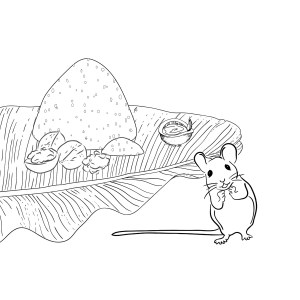
    Since I can’t see well enough to use a pencil anymore, and since the thought of AI art or writing makes my soul break out in hives, my on best bet for art is what I can remember of Photoshop from about 25 years ago, plus a Depositphotos standard license for art that authors and creators are allowed to remix and use professionally. This particular image came from assembling about 5-6 pieces of licensed stock line art over several hours of squinting at previews and careful composite editing.

    A delighted mouse squeaks with enthusiasm for Shai Madhur's mouse-sized feast of rice and treats on a banana leaf with a little walnut shell diya lamp burning.

    In “The Potter’s Dream,” one of the three novellas in Chai and Cat-tales, Shai Madhur is tasked with trying to keep the mice out of the grain, and despite the fact that he lives in the Temple of Bastet, he’s just not good at un-welcoming anything, even the mice. So he prayed over a festival meal for the mice and made a little mandala of grain and pigments to see where they went afterwards.

    The mice, of course, very helpfully left brightly pigment-colored footprints all over the grain sacks once they’d finished receiving his blessings and his festival meal.

    In a different fantasy, the mice would have been obediently willing to go the other direction. But I’ve had a few too many difficulties convincing mice that no they really did not want to be in a house with both me and a cat who grew up wild and still had no qualms at all about mouse-hunting.

    (I had qualms about his mouse-hunting. For many years my cat seemed determined to repeatedly and not-very-patiently teach me, his clearly hunting-impaired provider of dry crunchy cat food, what was necessary to do to turn mice into juicy tasty food. The mice were persistently stupid enough to keep providing my mighty little hunter with educational materials for his hunt-reluctant human.)

    My mighty hunter has since crossed over to hunt the mice in kitty heaven. But I’m still as little inclined as Shai Madhur to hurt the mice myself. (And I adore that mouse in the art beyond all reason.)

    So I’m crossing a couple streams here with the intersection of Japanese furikake and onigiri and Middle Eastern za’atar, because I think the temple mice would approve.

    The Mouse’s Festival

    • Either 3/4 to 1 1/2 cups (1 or 2 rice cooker portions) of uncooked rice, or leftover rice from takeout
    • Shai Nanda’s lemon-rubbed cheese, if she will give you the recipe, or some feta sprinkled with olive oil and lemon juice
    • Any additional protein of your choice (beef, chicken, falafel…)
    • Your choice of any convenient and tasty mezze: hummus, baba ghanoush, tabbouli, dal, olives, dates, dolma, whatever you enjoy
    • Your choice of za’atar, furikake, or mixed herbs
      • If you don’t have pre-made za’atar at hand, but you do have sumac, thyme, oregano, and sesame seeds: Mixing about 1 Tbsp of each of them together and toasting them for a couple minutes in a warm dry pan, then adding a sprinkle of salt, gets you za’atar. But Penzey’s za’atar is also tasty and I like supporting the Resistance.

    Rice:

    • If you want to shape your sushi rice, you’ll want to cook short grain sushi rice fresh. It will hold together in filled balls with ingredients tucked in the middle and/or sprinkles on the outside.
    • If you don’t care about shaping it, you can use long grain jasmine or basmati, or anything leftover from takeout.

    Other ingredients:

    • If you have finger bowls or katori from thali or other cute small containers, plate up your protein and mezze with them. If not, you could use lettuce leaves or nori squares or just dot them wherever you like.

    Time to eat:

    • If you have a banana leaf, set it out.
    • If you don’t, get a fancy plate or bamboo mat or something that makes you feel festive. Small bowls are fun and mouse-friendly too.
    • If you like rice balls filled with tasty stuff, take fresh-cooked sushi rice and tuck your protein in the middle and shape it. (If your hands are heat sensitive, you can get an assist from a quick swipe of olive oil in a teacup, then use the teacup as a mold. If you feel particularly festive, you could use silicone muffin molds or even flowers.)
    • If shaping rice balls is too much fuss, cook or reheat whatever rice you’ve got. You can entertain your inner mouse with teacups of rice covered with assorted nibbles and sprinkles with less hand scorching.
    • Sprinkle your za’atar or furikake on your rice and anything it looks tasty with, for a nod toward the mouse dance party.

    Other delicious stuff to do with za’atar:

    • Sprinkle on Greek yogurt for quick simple and tasty veggie or bread dips
    • Blend with olive oil and toast on pita or saj
    • Sprinkle on pizza (especially when there are olives and grilled onions involved)